Built on Neighbors, Not Narratives
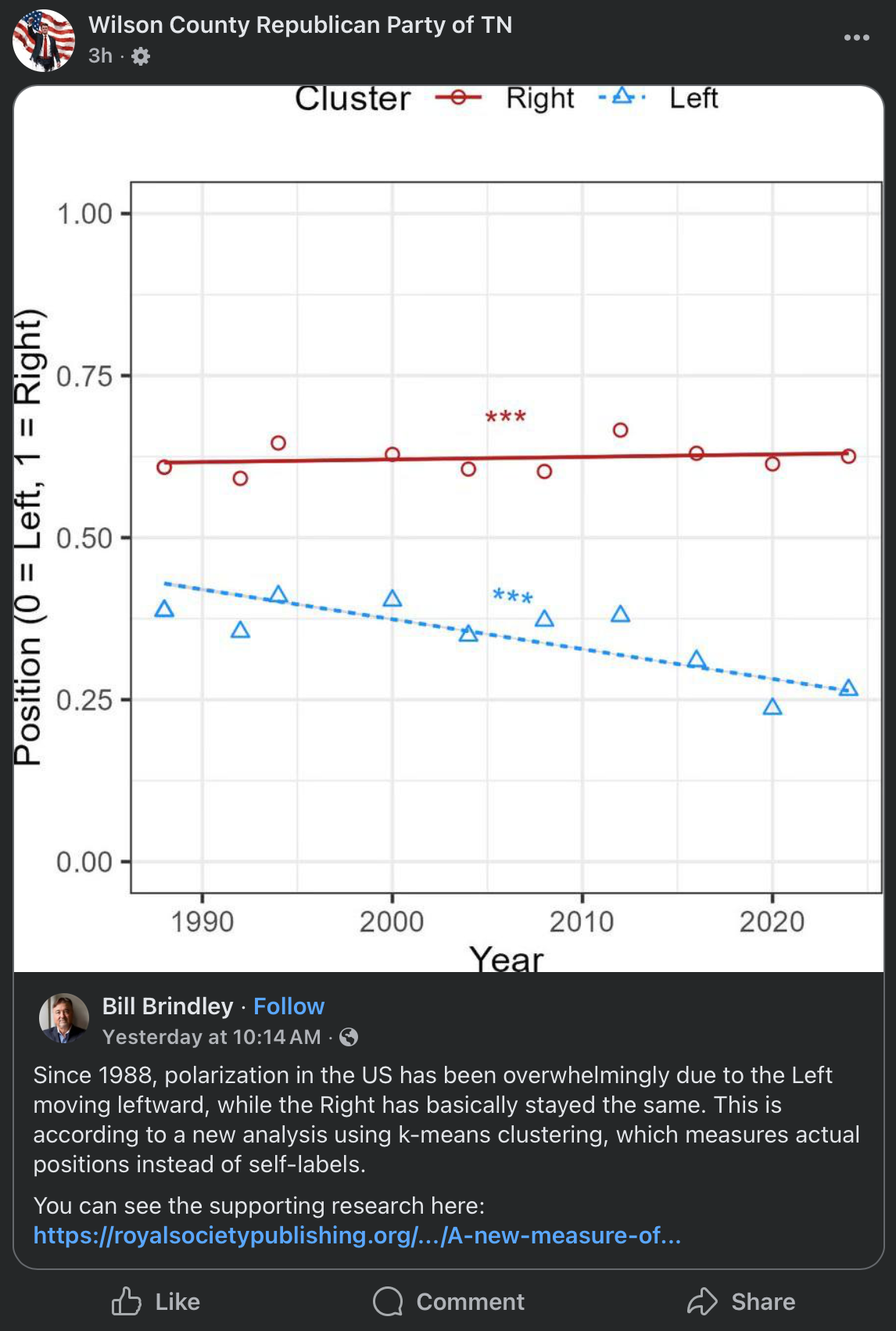
The Wilson County Republican Party is sharing a graphic from a study that claims polarization in America is happening because the left keeps moving further left while the right stays put.
But that is not what the underlying research actually shows. And more importantly, that framing misses the real danger unfolding beneath our politics.
Let us slow this down and look at what the data is really telling us.
The study being cited uses a method called k means clustering. In plain language, it looks at where people actually land on a wide range of issues rather than where they say they land on a left right label. It groups people based on patterns of belief and then tracks how those groups change over time.
What it finds is not a story of one side marching off a cliff while the other stands still. What it finds is something more unsettling and more honest.
Groups are pulling away from each other.
They are becoming more internally uniform. More tightly bound. More suspicious of those outside the group. And the distance between those groups is growing.
That separation is not primarily about tax rates or infrastructure spending. It is increasingly about culture, identity, and belonging. About who people believe they are and who they believe threatens that identity.
When politics moves from policy to identity, disagreement hardens. Compromise stops feeling like problem solving and starts feeling like betrayal. And that hardening can look like radicalization even when it is happening on multiple sides at the same time.
That is the key point missing from the viral claim.
Polarization today is less about ideology drifting in one direction and more about Americans sorting themselves into rival camps that share fewer values, fewer assumptions, and fewer shared facts. The data shows divergence, not a one way slide.
Why does this matter
Because once politics becomes identity driven, everything escalates. School boards turn into battlegrounds. Public health becomes tribal. Local planning meetings feel like national culture wars played out in miniature. And the people who suffer first are not politicians or pundits. They are families, teachers, first responders, small business owners, and local communities trying to function.
This is especially dangerous at the local level.
County government is not supposed to be an ideological coliseum. It is supposed to make sure roads are safe, budgets are responsible, emergency services work, and growth is managed wisely. When national identity conflicts get imported into local decision making, nothing gets fixed and everyone loses.
That is why simplifying polarization into a left versus right blame game is not just inaccurate. It is corrosive.
It lets us avoid the harder truth. That we are being pulled apart not just by what we believe, but by who we think we are and who we think the other side is.
And here is the hopeful part.
Identity driven polarization is learned. Which means it can be unlearned.
At the local level especially, we still have the power to re center politics on shared interests. Safe neighborhoods. Strong schools. Transparent budgets. Respectful governance. These are not left or right ideas. They are community ideas.
Leadership matters here.
Leadership that refuses to inflame cultural panic for clicks or clout. Leadership that speaks plainly, listens seriously, and governs for the whole community not just the loudest faction. Leadership that understands disagreement does not require dehumanization.
The data does not demand that we pick a side and dig in deeper. It warns us what happens when we do.
The real lesson is not that one group is to blame. The lesson is that when identity replaces policy, democracy starts to fray.
And the work in front of us is to pull it back together. Locally. Practically. With humility and with courage.
That is the kind of politics worth fighting for. And the kind of leadership I am committed to bringing to Wilson County.
Link to Full Study: https://royalsocietypublishing.org/rsos/article/13/2/251428/479919/A-new-measure-of-issue-polarization-using-k-means?fbclid=IwY2xjawPxx61leHRuA2FlbQIxMABicmlkETFQa0ViVWc4emw2V3NScnJoc3J0YwZhcHBfaWQQMjIyMDM5MTc4ODIwMDg5MgABHhTNn2T_iYl1gBhA3EG1JBWtxDw1_XlRxu41zZSyT9YzOtZyD0XtDU5VMNAA_aem_OS8jKA0VScBAxi_wsbwGbA