
Competence Over Faith

There is a temptation in politics to speak in abstractions.
Values. Freedom. Faith. Tradition.
But government is not abstract. It is specific. It is measurable. It is accountable.
In Wilson County, public office is not a platform for identity. It is a responsibility for outcomes.
If someone claims Christian values as a qualification for leadership, that deserves respect. Faith shapes conscience. It can deepen humility. It can inspire service.
But Scripture does not treat belief as a substitute for ability.
Micah reduces leadership to three obligations. Do justice. Love mercy. Walk humbly with your God. Micah 6:8.
Jesus frames the moral law relationally. Love the Lord your God. Love your neighbor as yourself. Matthew 22:37 to 39.
And when Scripture describes those fit to govern, it uses practical language. Able men. Men of truth. Hating covetousness. Exodus 18:21.
Able is not decorative language. It is administrative language.
Able means you understand a school budget.
Able means you can distinguish recurring revenue from one time funds.
Able means you know that borrowing money is not the same thing as solving a problem.
Justice in a county context is not theoretical. It is whether a child in a crowded classroom receives the same opportunity as one in a better funded zone. Scripture warns against partiality. You shall not be partial to the poor or defer to the great, but in righteousness shall you judge your neighbor. Leviticus 19:15.
Mercy is not sentimental. It is whether emergency services are properly funded so response times do not depend on geography. Where there is no guidance a people falls, but in an abundance of counselors there is safety. Proverbs 11:14.
Humility is not weakness. It is restraint. It is the discipline to admit when projections were wrong. It is the courage to say no when a proposal is popular but fiscally reckless. To whom much is given, much will be required. Luke 12:48.
Now consider the American framework.
The Constitution states plainly that no religious test shall ever be required as a qualification to any office or public trust. Article VI, Clause 3.
Government derives its just powers from the consent of the governed. Declaration of Independence.
The First Amendment prevents establishment of religion and protects free exercise.
That boundary is intentional.
The system was built to ensure public authority is exercised under law, not awarded through creed.
Now let us talk about qualifications.
Not slogans.
Not yard signs.
Not who can quote which verse the fastest at a fish fry.
Actual qualifications.
Because after all the noise about who has the right values, the more important question is this:
What actually qualifies someone to lead Wilson County?
If we are serious about self government, we should be serious about the answer.
Wilson County is not symbolic office. It is not a pulpit. It is not a culture war command center.
It is a growing county in Tennessee facing real pressures.
Population growth.
School capacity challenges.
Rising property values.
Public safety demands.
Budget constraints.
This is not abstract. This is asphalt. Emergency response times. Capital improvement plans. Enrollment projections. Debt schedules.
So here is what actually qualifies a leader in Wilson County.
First, constitutional discipline.
The oath of office is to the Constitution and the laws of the State of Tennessee. That matters. A qualified leader understands what authority the county has and what it does not have. They do not campaign on powers the county does not possess. They do not stretch authority to fight symbolic battles.
They govern within guardrails.
Second, fiscal literacy.
If you cannot read a budget, you are not ready to write one.
Wilson County operates on millions of dollars in revenue and long term obligations. Debt structures. Infrastructure cycles. Pension liabilities. School construction. Public safety equipment.
These are not moral abstractions. They are line items.
A qualified leader understands tradeoffs. Every dollar allocated to one priority is a dollar not allocated somewhere else. Serious people can explain those tradeoffs honestly.
Scripture warns against distorted judgment and bribery. You shall not take a bribe, for a bribe blinds the clear sighted. Exodus 23:8. It condemns favoritism. Show no partiality as you hold the faith. James 2:1.
Budgets reveal whether we believe those verses.
Third, stewardship of growth.
Wilson County is not static. Growth is coming whether we posture about it or not. The question is whether it is managed responsibly.
A qualified leader understands long term school enrollment projections, infrastructure strain, and how today’s approvals shape tomorrow’s taxes. Growth without planning becomes congestion. Planning without discipline becomes stagnation.
Stewardship means balance.
Fourth, public safety competence.
Supporting law enforcement is not a bumper sticker. It is budget allocation, training standards, equipment investment, emergency response coordination, and constitutional compliance.
Order matters. So do rights.
Authority must operate within due process.
Fifth, fairness in application of the law.
No favoritism.
No quiet deals.
No selective enforcement.
Equal application of rules builds trust across ideological lines. That is not progressive or conservative. That is foundational.
Sixth, emotional steadiness.
Local government meetings can become heated. The qualified leader does not inflame tension for applause. They remain calm. They listen. They respond with facts.
Steady leadership lowers the temperature of the entire room.
Seventh, respect for pluralism.
Wilson County includes conservatives, liberals, evangelicals, Catholics, people of other faiths, and people of no faith.
A qualified leader understands that public policy binds everyone. Personal belief may guide character, but public authority must serve the whole community.
Piety is personal. Policy is public.
Eighth, transparency and integrity.
Open meetings compliance. Clear communication. No back room maneuvering.
We aim at what is honorable not only in the Lord’s sight but also in the sight of man. Second Corinthians 8:21.
Trust is built through sunlight.
Now let me say something plainly.
I am a Christian.
My faith shapes my character. It challenges me to be honest, disciplined, and accountable. It reminds me to seek the welfare of the city. Jeremiah 29:7.
But it does not qualify me to manage a county budget or oversee school construction.
Competence does that.
Study does that.
Experience does that.
Discipline does that.
Integrity is not exclusive to one religious group. Fiscal literacy is not a theological gift. Constitutional loyalty is not a denominational trait.
What qualifies a leader in Wilson County is not the label they wear. It is the steadiness with which they execute limited authority under law.
We do not need louder rhetoric.
We need disciplined stewardship.
We need leaders who understand that the county commission is not a stage for cultural performance. It is a responsibility to manage shared resources wisely.
We need leaders who can explain a tax decision without hiding behind ideology.
We need leaders who can say no to pressure when the law requires it.
We need leaders who think in decades, not election cycles.
Because much has been entrusted.
And much is required.
The promise of local government is not that everyone will agree. The promise is that power will be exercised within limits, fairly, competently, and transparently.
Not a creed.
Not a slogan.
Stewardship under law.
And Wilson County deserves nothing less.
Built on Neighbors, Not Narratives
At the local level especially, we still have the power to re center politics on shared interests. Safe neighborhoods. Strong schools. Transparent budgets. Respectful governance. These are not left or right ideas. They are community ideas.
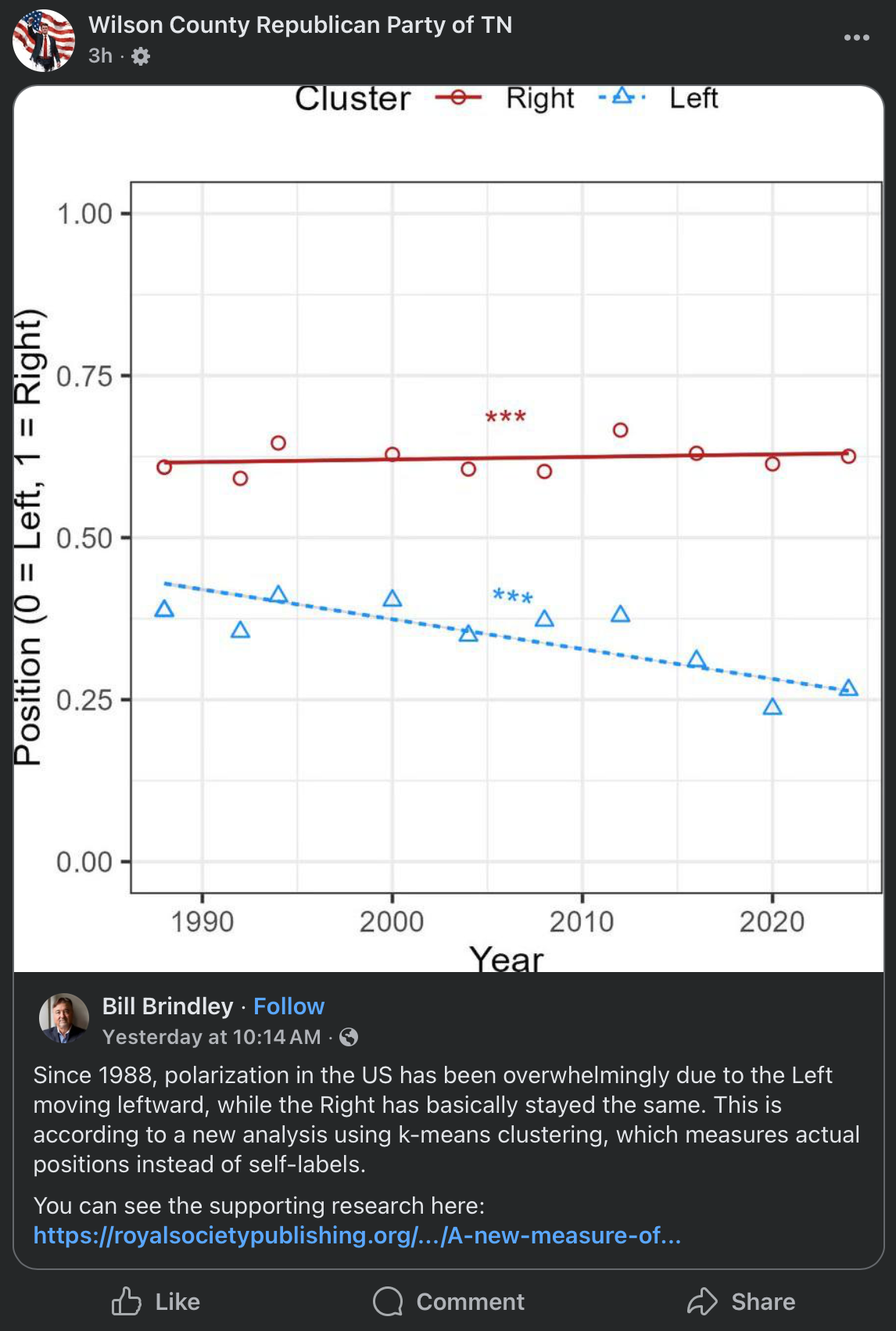
The Wilson County Republican Party is sharing a graphic from a study that claims polarization in America is happening because the left keeps moving further left while the right stays put.
But that is not what the underlying research actually shows. And more importantly, that framing misses the real danger unfolding beneath our politics.
Let us slow this down and look at what the data is really telling us.
The study being cited uses a method called k means clustering. In plain language, it looks at where people actually land on a wide range of issues rather than where they say they land on a left right label. It groups people based on patterns of belief and then tracks how those groups change over time.
What it finds is not a story of one side marching off a cliff while the other stands still. What it finds is something more unsettling and more honest.
Groups are pulling away from each other.
They are becoming more internally uniform. More tightly bound. More suspicious of those outside the group. And the distance between those groups is growing.
That separation is not primarily about tax rates or infrastructure spending. It is increasingly about culture, identity, and belonging. About who people believe they are and who they believe threatens that identity.
When politics moves from policy to identity, disagreement hardens. Compromise stops feeling like problem solving and starts feeling like betrayal. And that hardening can look like radicalization even when it is happening on multiple sides at the same time.
That is the key point missing from the viral claim.
Polarization today is less about ideology drifting in one direction and more about Americans sorting themselves into rival camps that share fewer values, fewer assumptions, and fewer shared facts. The data shows divergence, not a one way slide.
Why does this matter
Because once politics becomes identity driven, everything escalates. School boards turn into battlegrounds. Public health becomes tribal. Local planning meetings feel like national culture wars played out in miniature. And the people who suffer first are not politicians or pundits. They are families, teachers, first responders, small business owners, and local communities trying to function.
This is especially dangerous at the local level.
County government is not supposed to be an ideological coliseum. It is supposed to make sure roads are safe, budgets are responsible, emergency services work, and growth is managed wisely. When national identity conflicts get imported into local decision making, nothing gets fixed and everyone loses.
That is why simplifying polarization into a left versus right blame game is not just inaccurate. It is corrosive.
It lets us avoid the harder truth. That we are being pulled apart not just by what we believe, but by who we think we are and who we think the other side is.
And here is the hopeful part.
Identity driven polarization is learned. Which means it can be unlearned.
At the local level especially, we still have the power to re center politics on shared interests. Safe neighborhoods. Strong schools. Transparent budgets. Respectful governance. These are not left or right ideas. They are community ideas.
Leadership matters here.
Leadership that refuses to inflame cultural panic for clicks or clout. Leadership that speaks plainly, listens seriously, and governs for the whole community not just the loudest faction. Leadership that understands disagreement does not require dehumanization.
The data does not demand that we pick a side and dig in deeper. It warns us what happens when we do.
The real lesson is not that one group is to blame. The lesson is that when identity replaces policy, democracy starts to fray.
And the work in front of us is to pull it back together. Locally. Practically. With humility and with courage.
That is the kind of politics worth fighting for. And the kind of leadership I am committed to bringing to Wilson County.
Link to Full Study: https://royalsocietypublishing.org/rsos/article/13/2/251428/479919/A-new-measure-of-issue-polarization-using-k-means?fbclid=IwY2xjawPxx61leHRuA2FlbQIxMABicmlkETFQa0ViVWc4emw2V3NScnJoc3J0YwZhcHBfaWQQMjIyMDM5MTc4ODIwMDg5MgABHhTNn2T_iYl1gBhA3EG1JBWtxDw1_XlRxu41zZSyT9YzOtZyD0XtDU5VMNAA_aem_OS8jKA0VScBAxi_wsbwGbA
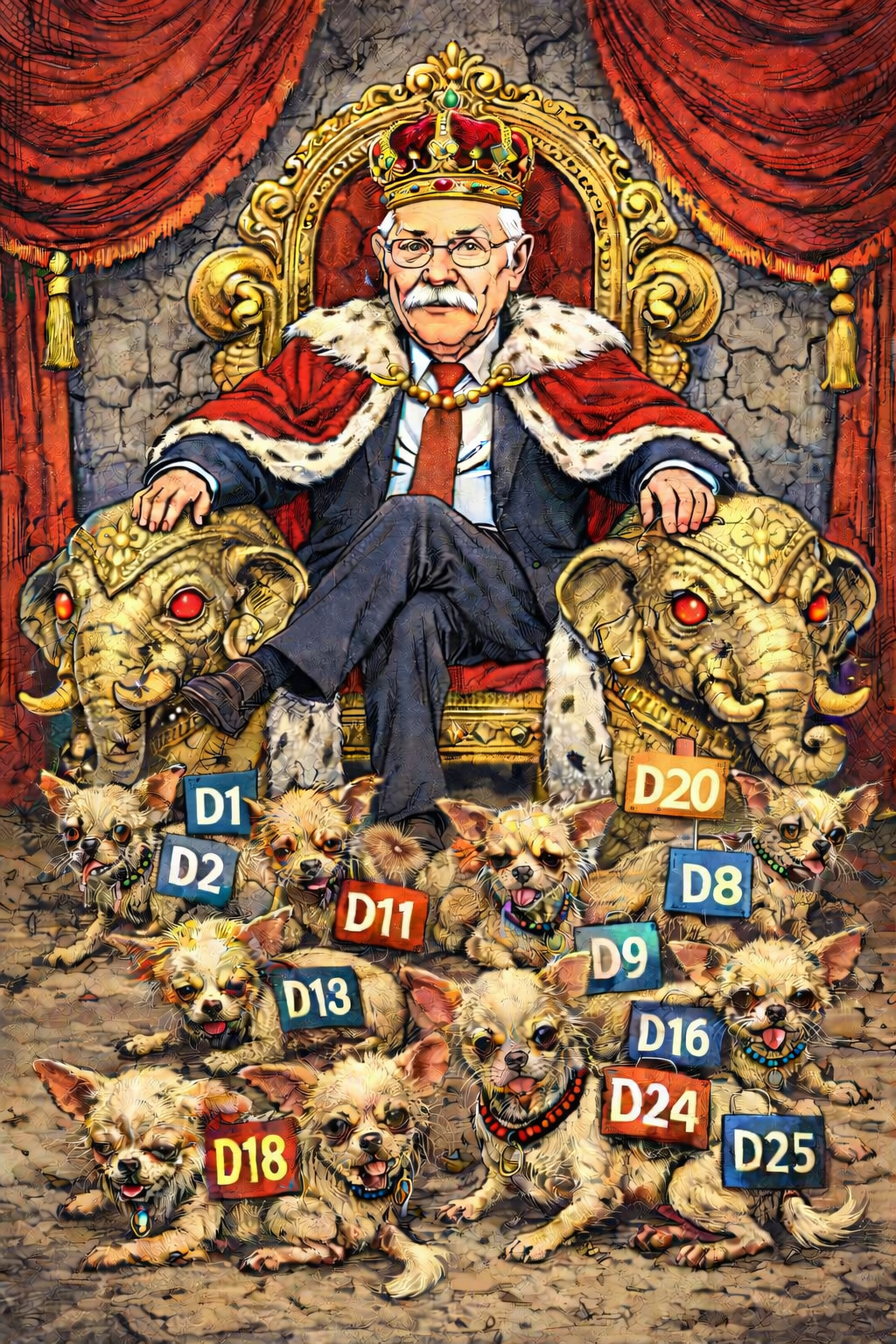
A King, His Lap Dogs, and Our Kids
I heard a lot about the letter next to a name. I heard a lot about primaries. I heard a lot about party power.
What I did not hear, from Mack or from the people pushing him the hardest, was a sustained focus on kids as kids.
Not students as props in an ideological fight.
Not children reduced to bathroom slogans.
Not families used as punctuation in a partisan press release.
They Chose a Letter Over Our Children
I keep thinking about the simplest, most basic question that should have been impossible to dodge on January 20, 2026, when the Wilson County Commission met to fill the Zone 5 school board vacancy.
What did you hear from the public that made you believe Kevin Mack was the best caretaker of our kids’ future for the next seven months?
Not what you heard from a party. Not what you heard from a consultant. Not what you heard from a threat of a primary. Not what you heard from Facebook groups whipping themselves into a frenzy.
What you heard from the people. The parents. The teachers. The students. The taxpayers who fund the schools and the families who trust the schools.
Because that is the job. That is the whole job.
Instead, we got a night that felt less like a community trying to protect its children and more like a community being dared to pick a team jersey.
And in the end, thirteen commissioners voted to appoint Kevin Mack.
And I am disappointed. Not in the abstract. Not in some vague “politics is broken” way.
I am disappointed because the vote, and the rhetoric that pushed it, reads like a decision to choose politics over kids and their futures.
How We Got Here
This vacancy did not appear out of nowhere. Zone 5 opened because the prior board member resigned after being arrested and charged in an indecent exposure investigation. The county’s own public notice laid out the vacancy, the legal timeline, and the fact that the appointment was meant to bridge to the August 2026 election. The resignation and related criminal charges were widely reported across local news outlets.
So the assignment was clear.
Pick a steady hand. Pick someone who can keep the district stable. Pick someone who will show up, learn, listen, vote carefully, and get out of the way so the voters can decide in August.
That is what many people came to the microphone believing they were there to talk about.
But then the meeting happened.
Two Candidates, Two Arguments, One Commission
There were two main candidates discussed in the meeting and in public comments.
Larry Tomlinson framed his pitch around experience and continuity. He leaned on his years of prior public service and emphasized working relationships, safe schools, equal opportunity, and the idea that governing should require putting personal feelings aside and doing the public’s business. He also addressed the pressure campaign directly, saying commissioners had been put in a bad position by people warning of primaries if they did not vote for someone “with an R by their name,” and he called that bullying.
Kevin Mack framed his pitch around fiscal management and growth. He talked about budget experience, including city projects during his Mount Juliet tenure, economic development that grew sales tax revenues, running debt free in business, and what he called preserving Tennessee’s low tax heritage. He also spoke about career and technical education, STEM, and his teaching experience in advanced manufacturing and mechatronics. And he added that he holds socially conservative views, citing issues like right to life, the Second Amendment, transgender related policies, and library materials.
Those are the candidates’ statements.
Now here is where the meeting took a turn.
Because what flooded the room, again and again, was not a debate about students. It was a debate about partisan identity.
What Support for Tomlinson Sounded Like
People who spoke for Tomlinson generally made a caretaker argument.
A longtime Zone 5 resident said Tomlinson had been an outstanding school board member, understood the board’s purpose, supported public education, and could step in quickly for the limited term. Another speaker argued the commission should avoid appointing anyone who intended to run in August because incumbency tilts the playing field, and that voters should decide the long term seat in the booth.
A retired educator and former county commissioner urged the commission to reject partisan pressure and make the decision based on experience and proven track record, saying party labels did not belong in a local school board seat.
Others echoed the same themes: stability, character, proven leadership, and the idea that this appointment should be a temporary bridge until voters make the final call.
You do not have to agree with every word of that case to recognize the shape of it.
It was about the job. It was about continuity. It was about keeping the system steady for students, staff, and families.
What Support for Mack Sounded Like
Support for Mack leaned heavily on partisan math and culture war messaging.
Brad Lytle, identifying himself as the Wilson County Republican Party chair, told commissioners the partisan nature of the races “wasn’t me, it was the state legislature,” then listed party values and urged them to “put a Republican in the seat in zone five.” He framed the choice as honoring the last election’s vote totals and argued the results already answered what Zone 5 wanted.
Sophie Moore called Mack the most qualified and highlighted his résumé, including budgets, road projects, and the lack of city property tax in Mount Juliet. She praised him as one of the best mayors Mount Juliet has had and then pivoted to the idea that Zone 5 voters overwhelmingly want a Republican in the seat.
Terry Nicholson, a member of the Tennessee Republican Party board, similarly argued that partisan identification empowers voters and cited the share of Zone 5 voters who chose the Republican candidate in the most recent election, urging commissioners to appoint Mack.
Perry Neal supported Mack as a neighbor and said he voted Republican in the last Zone 5 election. He also said he had nothing negative to say about Tomlinson and called it a win win, while still endorsing Mack and urging unity after the vote.
Then there was Jason Moore, who took the microphone after Sophie Moore and did something different: he attacked Tomlinson as fiscally irresponsible, accusing him of blowing budgets, backing out of a sales tax agreement, overseeing expensive projects, and contributing to insurance shortfalls.
That is the Mack coalition as presented that night: the party chair, party officials, partisan election math, cultural wedge issues, and a prosecutorial attack on the other candidate’s spending record.
Now I want to say something plainly, because context matters.
I heard a lot about the letter next to a name. I heard a lot about primaries. I heard a lot about party power.
What I did not hear, from Mack or from the people pushing him the hardest, was a sustained focus on kids as kids.
Not students as props in an ideological fight.
Not children reduced to bathroom slogans.
Not families used as punctuation in a partisan press release.
I mean kids as living, breathing, specific human beings in Wilson County who need reading intervention, who need safe transportation, who need special education services that work, who need teachers who can afford to stay, who need classrooms that are not overcrowded, who need mental health supports that are real, who need career pathways that are funded, who need honest budgeting that does not blow up in December.
And that is the heartbreak of this meeting. The loudest pro Mack messaging was political. It was branding. It was the triumph of a team sport.
The Vote That Appointed Mack
The commission’s tally sheet shows the final vote.
Kevin Mack received 13 votes.
Larry Tomlinson received 9 votes.
One commissioner abstained.
Two were absent.
On the final vote, the commissioners who voted for Mack were: Robert Fields, Rick Brown, Bobby Franklin, Chad Barnard, Kevin Costley, Blake Hall, John Gentry, Jeremy Hobbs, Diane Weathers, Lauren Breeze, Glenn Denton, Danny Clark, and Justin Smith.
The commissioners who voted for Tomlinson were: Terry Scruggs, Haskell Evans, Tommy Jones, Chris Dowell, Rusty Keith, William Glover, Mike Kurtz, Wendell Marlowe, and Jeremy Reich.
Tyler Chandler abstained.
Jerry McFarland and Beth Bowman were absent.
That is not rumor. That is the recorded tally.
So here is my question, directly to the thirteen commissioners who voted for Mack.
My Request to the Thirteen
Please share what feedback and comments you received from the public that encouraged you to vote for Kevin Mack.
Not what you received from party leadership.
Not what you received from partisan activists.
Not what you received from threats about primaries.
I mean the substance.
What did Zone 5 families tell you they needed from this appointment between now and August?
What did teachers tell you they needed?
What did parents tell you they feared?
What did students, if any reached you, tell you they wanted their board to prioritize?
What was the actual child centered rationale that outweighed the caretaker case made for the alternative?
Because if the answer is “the voters chose Republican last time,” then please say that out loud.
Say plainly that the deciding factor was partisan loyalty.
And then explain to every parent in Zone 5 why that is acceptable when we are trying to recover trust after a vacancy born from scandal.
This Is Not a Game
We are talking about the institution that carries the weight of our community’s future.
Public schools are not an accessory to politics. They are the engine of opportunity.
They are where we decide, in practice not in slogans, whether we believe every child matters.
And I am not asking for perfection. I am asking for priorities.
If you can fill a room with passionate speeches about the letter next to someone’s name, but you cannot fill the same room with specific commitments to student outcomes, safety, staffing stability, and responsible governance, then you have made the point. Just not the point you think you made.
The Part That Still Matters
The good news is that this appointment is temporary. The county notice was clear that the seat ultimately goes back to the voters in August 2026.
So here is what comes next.
If the commission chose politics, then the public’s job is to choose accountability.
Ask harder questions.
Demand specifics.
Make every candidate, including Mack, answer for students as students. Not as abstractions. Not as culture war talking points.
Budgets. Class sizes. Facilities. Teacher retention. Special education compliance. Safety plans. Student supports. Academic recovery. Career pathways.
And yes, values matter. But values without governance are just performance.
So I will end where I started.
To the thirteen commissioners who voted for Mack, please share what you heard from the public that led you to that vote.
If your answer is strong, put it in the light.
If your answer is partisan, own it.
Either way, the public deserves to know.

What Wilson County Records and Tennessee Law Actually Say
Wilson County has a school board vacancy, and people are using it as a political tug of war. That is backwards. Schools exist for students, not for party scoreboards. If we are going to persuade our neighbors, we should do it with facts, not with spin.
Some of what is being shared online about school boards, taxes, and partisan elections is simply false. Spreading false claims to steer people emotionally is dishonest, and it is a disservice to families who are trying to make good decisions for our children.
Here is what the public record shows.
The vacancy process is about representation, not party ownership
Wilson County government has published the process for filling the vacant school board seat, and it is clear that the County Commission will appoint someone to serve until the public votes. The county notice also states, in plain language, that qualified candidates may apply regardless of political affiliation. In other words, this is not legally treated as a party seat that must be handed back to a party. It is a public seat meant to represent students and families in that zone.
If we want the strongest schools, the healthiest approach is to evaluate applicants by qualifications, temperament, and ability to govern, not by the letter next to their name.
School boards matter, but they do not control everything people claim they control
It is true that a school board has serious influence over school operations, policies, and what materials are used in classrooms. But two common claims being circulated are not accurate.
First, local school boards do not set Tennessee academic standards. Tennessee requires districts to provide a curriculum that meets or exceeds the academic standards adopted by the State Board of Education. Local boards and districts implement those standards and choose instructional materials within state rules, but they are not writing statewide standards from scratch.
Second, local school boards do not set county tax rates. In Tennessee, the county legislative body, meaning the County Commission, is the body that levies taxes. School boards build and approve an education budget request, but the tax levy is not theirs to set. Saying otherwise misleads taxpayers about who actually controls the rate.
Wilson County taxes: a flat rate is not the same thing as “the school board prevented tax increases”
The adopted Wilson County budget sets the county property tax rate at $1.9089 per $100 of assessed value. That number is in the county’s official budget document, not in anyone’s talking points.
Also in that same adopted budget, the General Purpose School Fund is budgeted at $225,809,374, with $135,451,208 budgeted for instruction. Those are the kinds of figures that actually matter for class sizes, staffing, services, and student support.
Here is the key honesty check. Even when the tax rate is flat, tax bills and total collections can still rise with reassessments, rising property values, and growth. And legally, the body that holds the pen on the tax rate is the County Commission, not the school board.
How Tennessee school board elections became partisan, and who drove it
For generations, many Tennessee school board elections were run as nonpartisan contests in the practical sense that candidates did not run with party labels on the ballot. That meant voters often focused more on experience, character, and competence than on party branding.
That changed in 2021. Tennessee passed Public Chapter 1 in the Third Extraordinary Session of 2021, and it created a legal pathway for partisan school board elections. This was not some kumbaya moment where both parties “came together” to offer candidates a friendly option. It was a state law change pushed through a legislature dominated by Republicans and signed by the Republican governor.
The mechanics matter, too. Tennessee law allows school board elections to be conducted on a partisan basis, and it allows a county party primary board to opt in. Reporting at the time highlighted that one party could trigger the shift even if the other party objected, which is exactly the kind of structural change that predictably increases polarization.
So yes, politics touches education because government touches education. But it is also fair, and historically accurate, to say Tennessee recently turned the temperature up by injecting party machinery more directly into school board elections.
Student outcomes should be the North Star
If someone wants to argue that a certain approach is working, the proof should not be vibes or slogans. The proof should be student outcomes and responsible stewardship.
Tennessee’s official State Report Card is designed for exactly this purpose. It includes district and school performance measures such as achievement, growth, graduation rate, readiness, discipline, and more. That is where families should look when they want to judge how well the system is serving students.
A kids first way to talk about this vacancy
The closing message Wilson County needs is simple and it should be said plainly.
Do not contact your County Commissioner and ask them to appoint a Republican or a Democrat.
Contact your County Commissioner and ask them to appoint the best person to support our children.
Ask for someone who will focus on literacy, math, safety, teacher support, special education, career readiness, and transparent budgeting. Ask for someone who can disagree without turning board meetings into a reality show. Ask for someone who understands what the school board actually controls, and what it does not.
Our kids deserve adults who tell the truth, read the law, follow the money, and keep the mission sacred.
My Story: Built by Family, Shaped by Service, Focused on the Future
When I think about policy, budgets, or growth, I am not thinking in abstract numbers. I am thinking about real households, real commutes, real classrooms, and real neighborhoods.
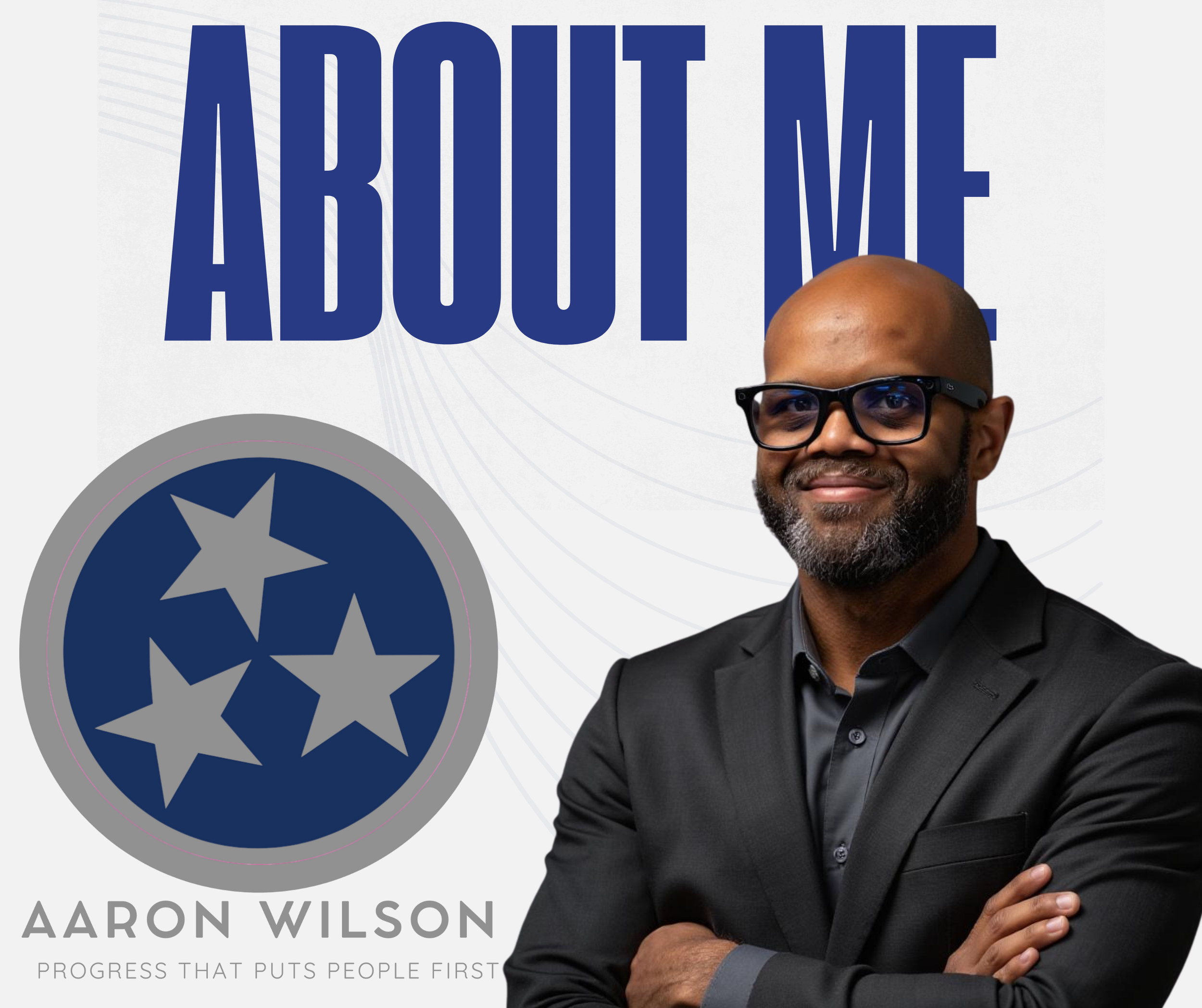
I am Aaron Wilson. I am a husband, a father, a lifelong learner, and yes, the tech guy who believes government should work the way people expect it to work. Clearly, honestly, and in service of the community it exists to support.
My professional life has been spent fixing systems, managing limited resources, and making sure the right work gets done the right way. That mindset does not stop at the office door. It shapes how I think about public service, leadership, and the future of Wilson County.
This campaign is not about noise or ideology. It is about people. It is about trust. And it is about doing the work with clarity and integrity.
Built by Family and Responsibility
Before I am anything else, I am a family man. My wife and children ground me. They keep my priorities straight and my decisions human. When I think about policy, budgets, or growth, I am not thinking in abstract numbers. I am thinking about real households, real commutes, real classrooms, and real neighborhoods.
Strong communities do not appear by accident. They are built through consistency, accountability, and leadership that remembers who it serves. That belief is at the heart of why I am running.
You can learn more about my background and personal journey on the Meet Aaron page, where I share how my experiences as a husband, father, and IT leader shaped my decision to step forward and serve.
A Career of Fixing What Matters
I have built my career around problem solving. In technology, excuses do not fix broken systems. Clear thinking does. Planning does. Ownership does.
Government should operate the same way.
People deserve public services that are reliable, efficient, and respectful of their time and tax dollars. That means making decisions based on evidence, not ego. It means asking hard questions early, not after mistakes become expensive. It also means being willing to say no when something does not serve the public good.
My approach is practical because reality demands it. Budgets are not infinite. Growth must be managed responsibly. Transparency is not optional. It is foundational.
Why I Am Running
I am running because I believe Wilson County deserves leadership that puts people first and treats public trust as sacred.
This is not about tearing anything down. It is about strengthening what already works and fixing what does not. It is about growth that is smart, fair, and grounded in common sense. It is about respecting our rural roots while preparing responsibly for the future.
On the Why page of my website, I talk openly about the values driving this campaign and the responsibility that comes with asking for your vote. Leadership is not about being seen. It is about being accountable.
The Issues That Matter Most
Every issue comes back to people. Safety. Infrastructure. Responsible development. Fiscal stewardship. Transparency. These are not partisan concepts. They are community necessities.
I believe in people first governance that listens before it decides. I believe in smarter budgets that stretch tax dollars instead of wasting them. I believe in supporting public safety while also planning for long term emergency readiness. I believe growth should benefit the whole county, not just a few interests.
You can explore my full platform on the Issues page, where each priority is explained with clarity and intention. These are not slogans. They are commitments.
A Steady Hand for a Changing County
Wilson County is growing. Growth brings opportunity, but it also brings responsibility. The wrong decisions made quickly can cost communities for decades. The right decisions made thoughtfully can strengthen them for generations.
I am offering steady leadership rooted in experience, guided by ethics, and focused on service. Not flashy. Not loud. Just honest work done with purpose.
This campaign is about building a county that works for everyone. One decision at a time. One conversation at a time. One act of trust at a time.
Did You Know: The Numbers Tell a Different Story in Wilson County
Wilson County is thriving. Growth is booming. Everything is moving in the right direction. That sounds good. But here is the uncomfortable truth. When you look past the headlines and into the data, the story gets a lot more complicated.
The growing narrative is that Wilson County is thriving. Growth is booming. Everything is moving in the right direction. That sounds good. But here is the uncomfortable truth. When you look past the headlines and into the data, the story gets a lot more complicated.
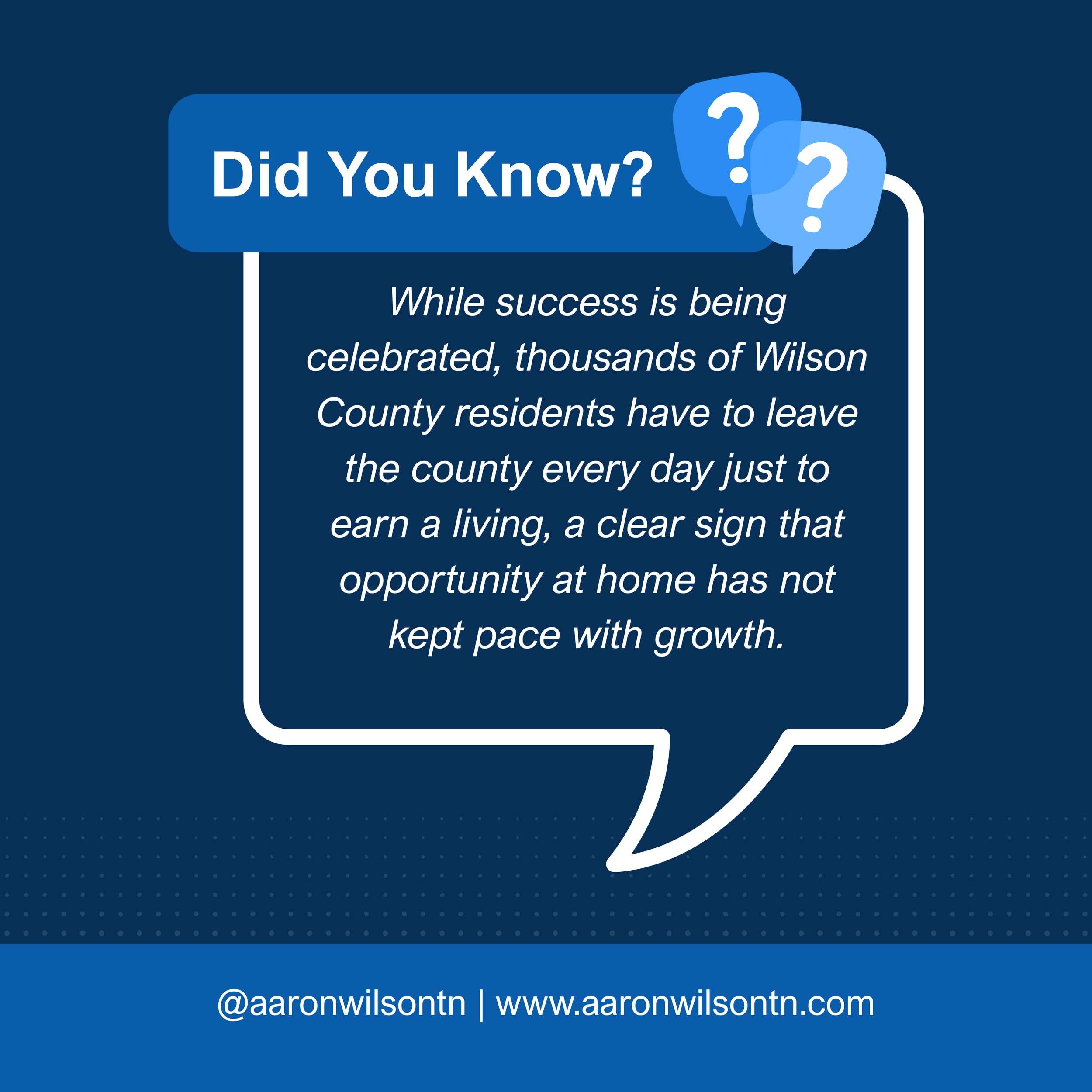
Start with jobs. Thousands of Wilson County residents still leave the county every single day to earn a paycheck. Long commutes are not a lifestyle choice for most families. They are a sign that local job growth is not keeping up with the people who live here. Time spent on the road is time away from kids, church, and community. Progress that forces people to leave home to survive is not the kind of progress we should be celebrating.
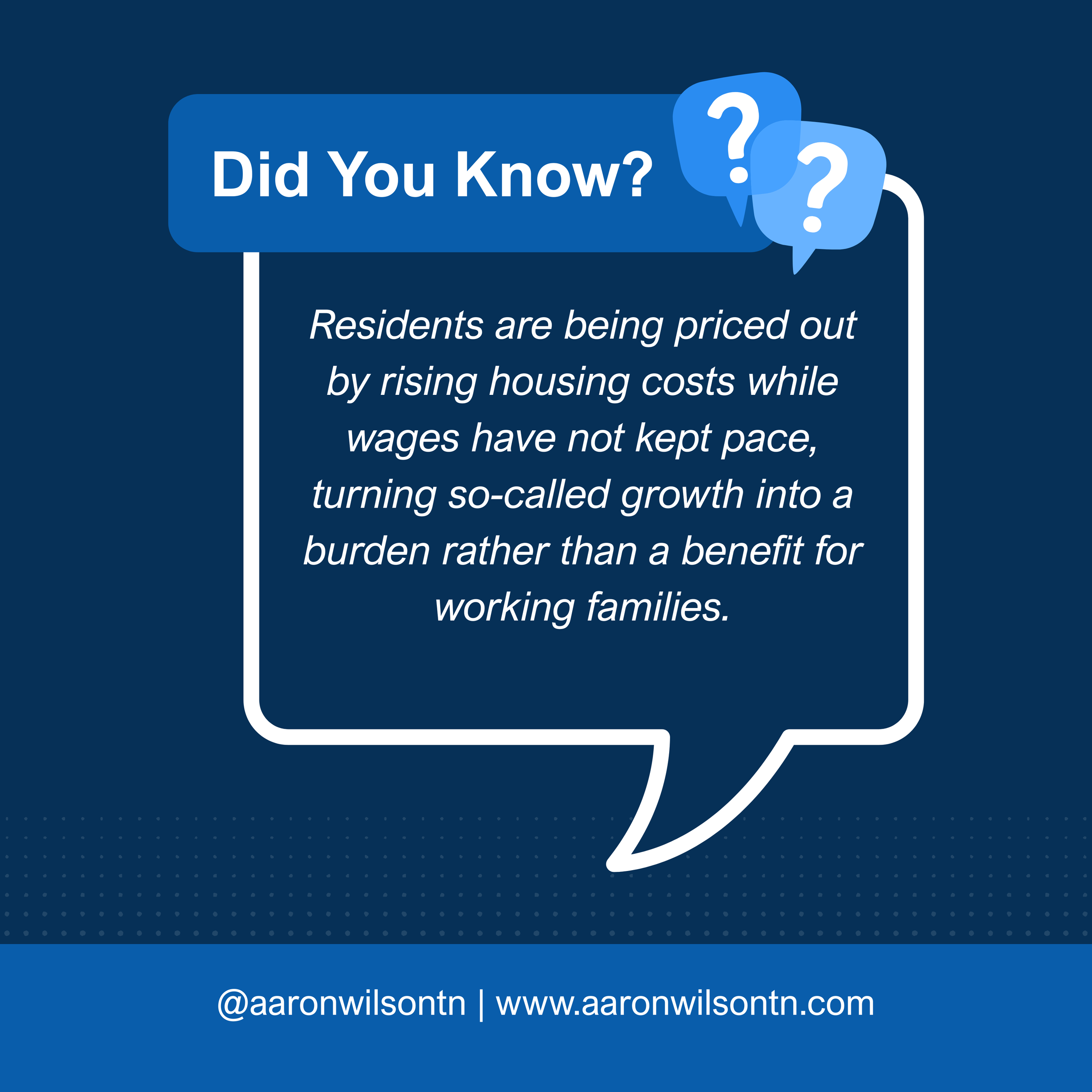
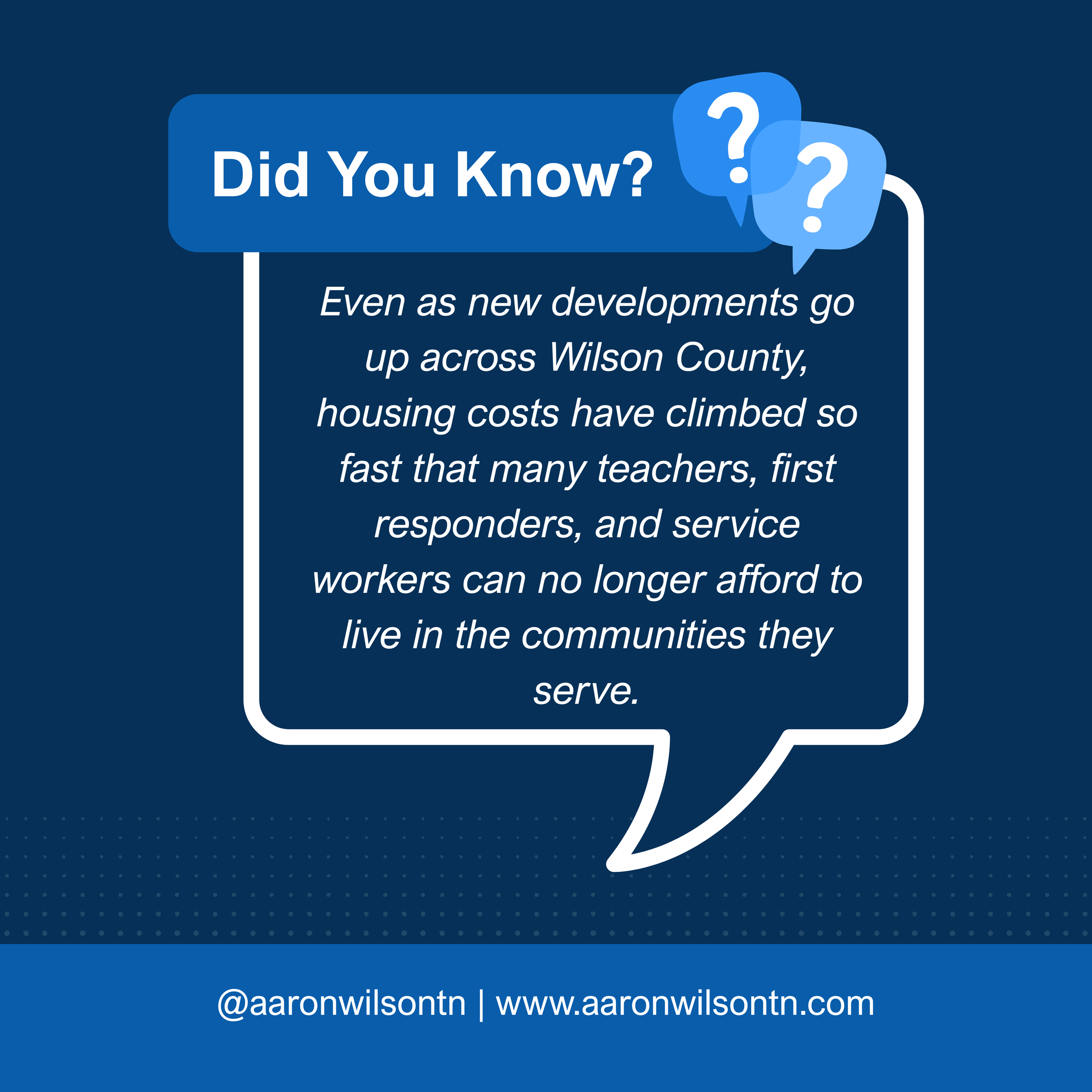
Now look at housing. Home prices and rents in Wilson County have risen fast, far faster than wages for working families. Teachers, deputies, nurses, and county employees are being priced out of the very community they serve. Growth that benefits investors but burdens residents is not success. It is displacement wearing a smile.
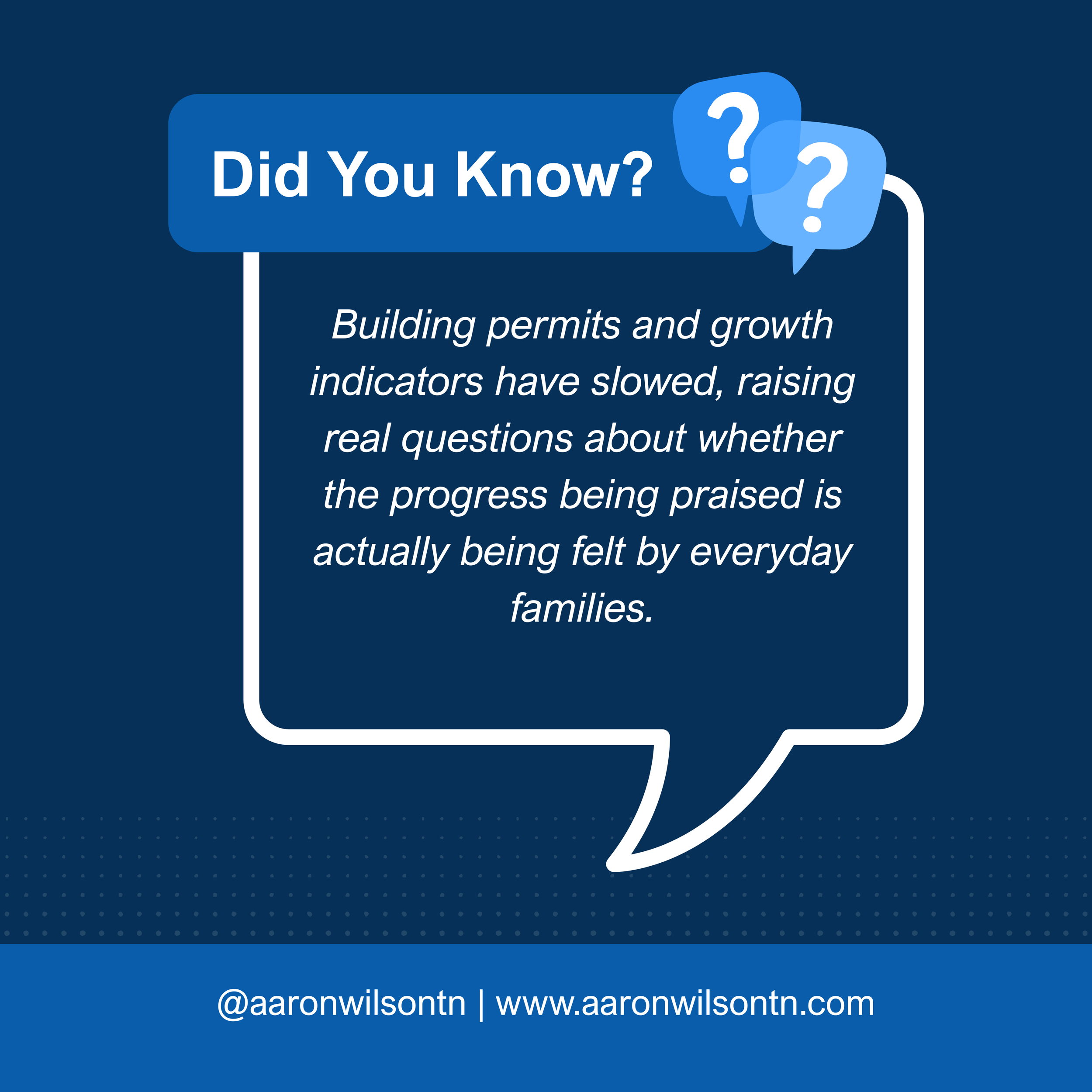
Then there is construction. Building permits have slowed from recent highs, even as prices remain high. That means fewer new homes coming online while demand keeps climbing. Less supply plus higher prices equals fewer options for everyday people. That is basic math, not political spin.
Here is the point. Wilson County has potential. Real potential. But potential only matters if it improves daily life for the people who already call this place home. Leadership is not about celebrating statistics that look good on paper. It is about confronting the ones that do not and fixing them.
We can build a Wilson County where people can work close to home, afford to live here, and feel the benefits of growth instead of the pressure of it. That requires honesty, accountability, and leadership willing to tell the whole truth even when it is uncomfortable.
That is the future worth fighting for.
Sources
Wilson County Economic Development Doing Business. Wilson Works Workforce Initiative.
Interactive Map AI Housing Data. Wilson County Tennessee Housing Market Overview.
Wilson County Tennessee Real Estate Overview.
New Private Housing Units Authorized by Building Permits Wilson County Tennessee.
Did You Know is a bite sized blog series that highlights surprising data and the real stories behind the numbers. Clear facts, real context, and zero nonsense because data should inform decisions, not collect dust.
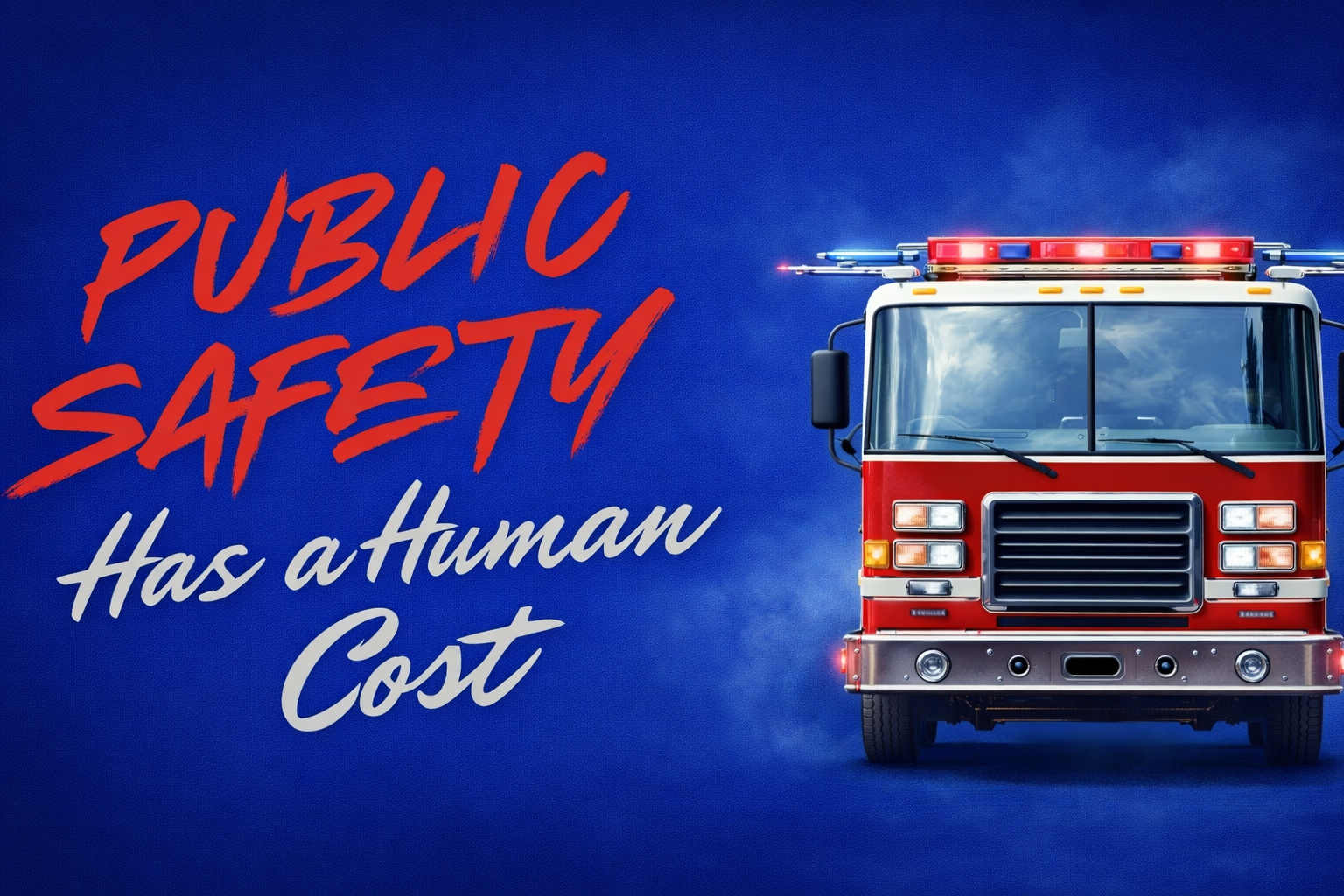
Past the Talking Points: Protecting Those Who Protect Us
Doing more with less is not a strategy. It is a warning sign. When firefighters and emergency responders are stretched thinner to meet growing demands, the cost does not disappear. It shifts into fatigue, deferred training, aging equipment, and increased risk on scene. What may look efficient on paper often becomes dangerous in practice. Responders adapt because they care, not because the system is working. When sacrifice replaces planning, leadership is no longer managing public safety, it is borrowing against the health and safety of the people doing the work.
The Human Cost of Public Safety and Our Responsibility to Act
Doing more with less is not a strategy. It is a warning sign. When firefighters and emergency responders are stretched thinner to meet growing demands, the cost does not disappear. It shifts into fatigue, deferred training, aging equipment, and increased risk on scene. What may look efficient on paper often becomes dangerous in practice. Responders adapt because they care, not because the system is working. When sacrifice replaces planning, leadership is no longer managing public safety, it is borrowing against the health and safety of the people doing the work.
Public safety is often discussed in terms of response times, budgets, and equipment. Those details matter, but they are not the full story. Behind every emergency call in Wilson County is a firefighter or emergency responder who carries both the immediate risk of the moment and the cumulative weight of a demanding profession. Public safety has a human cost, and responsible leadership begins by acknowledging it honestly.
Firefighters and emergency responders in Wilson County are being asked to do more as the county grows and emergencies become more complex. Increased development, higher call volumes, and evolving risks mean that responders are operating under constant pressure. Local firefighters have raised concerns about staffing levels, noting that some county stations operate with limited personnel, creating situations where responders must work harder and take on additional risk to meet community needs. These are not abstract concerns. They affect safety on scene and the long term health of the people doing the work.
The physical demands of emergency response are relentless. Firefighters routinely enter extreme environments involving heat, smoke, hazardous materials, and unstable structures. Over time, repeated exposure to these conditions places significant strain on the body. Injuries, chronic health issues, and long term physical wear are not anomalies. They are inherent risks of the profession.
Equally significant is the mental and emotional toll. Emergency responders witness trauma, loss, and human suffering as a routine part of their work. They are expected to remain composed, decisive, and ready for the next call, often without time to process what they have just experienced. Research on first responders shows that repeated exposure to traumatic events can contribute to post traumatic stress, anxiety, depression, and sleep disruption. These effects do not stay on the job. They follow responders home, impacting family life and overall well being.
Staffing shortages and resource constraints intensify these pressures. When departments are understaffed, individual responders shoulder heavier workloads, work longer hours, and face greater fatigue. In Wilson County, staffing challenges have led to creative but imperfect solutions, including the recruitment of uncertified firefighters who must be trained while already filling critical roles. While innovation in hiring is sometimes necessary, it underscores the need for thoughtful planning, adequate support, and strong training pipelines so responders are not placed in unsafe or unsustainable situations.
Beyond the physical and operational challenges lies a quieter but equally important issue. Many firefighters and emergency responders feel disconnected from the decisions that directly affect their safety and effectiveness. When budgets and policies are shaped without meaningful input from those on the front lines, it erodes trust and contributes to burnout. Public safety cannot be managed solely from spreadsheets or meeting rooms. It must be informed by lived experience.
My position is that leadership has a responsibility not only to fund public safety, but to understand it. That means recognizing physical and mental health as essential components of readiness, not personal issues to be managed privately. It means planning for adequate staffing levels, investing in modern training, and ensuring equipment is reliable and up to date. It also means listening to firefighters and emergency responders as professionals whose insight is critical to sound decision making.
The human cost of public safety is real and ongoing. Addressing it requires leadership that is willing to move beyond symbolic support and take concrete action. Wilson County deserves a public safety system that protects the community without sacrificing the health and well being of the people who serve it. Meeting that responsibility is not optional. It is the duty of those entrusted with leadership.
References
Firefighter staffing concerns in Wilson County
Hiring and staffing challenges within Wilson County emergency services
Don’t Just Register Vote Why Every Ballot Matters in Wilson County District 20
In local elections registering to vote is only half the battle actually showing up to cast your ballot is what makes democracy work
In local elections registering to vote is only half the battle actually showing up to cast your ballot is what makes democracy work. Nowhere is this more evident than in Wilson County’s District 20. This district saw extraordinarily low turnout in a recent election and the results demonstrate how a few votes or the lack of them can shape our community’s future. Below we break down what happened why it matters and how you can take action to ensure your voice is heard.
When Only 10 Percent Vote 3 Votes Decide the Election
In the August 4 2022 County Commission District 20 race only 215 individuals voted. That represents just 10.62 percent of the district’s registered voters. The current county commissioner was elected with only 109 votes which equals 5.38 percent of registered voters in the district. The election was decided by a margin of just 3 votes.
Three people determined who would represent the entire district.
That fact alone should stop all of us in our tracks.
When turnout is this low decisions that affect taxes roads schools zoning public safety and growth are made by a fraction of the community. Nearly 90 percent of registered voters in District 20 did not participate. That silence has consequences.
District 20 Has the Fewest Registered Voters in Wilson County
Wilson County is divided into multiple County Commission districts each designed to represent roughly the same number of residents. While exact population numbers fluctuate districts are generally structured to include between 16000 and 18000 residents per district based on census data and state redistricting requirements.
Despite this similar population structure District 20 currently has the lowest number of registered voters in the entire county.
Most Wilson County districts have between 3500 and 4500 active registered voters. District 20 has roughly 2000 active registered voters according to the most recent data from the Wilson County Election Commission.
That means District 20 is not smaller in population but it is significantly underrepresented in voter participation. Fewer registered voters combined with extremely low turnout creates a situation where the district’s voice is disproportionately quiet compared to other parts of the county.
This is not because District 20 matters less. It is because participation has been low for too long.
The Hidden Consequences of Low Voter Turnout and Apathy
Low voter turnout does not just affect who wins an election. It shapes how resources are allocated and how seriously a community is taken.
Elected officials pay attention to participation. Areas with consistent turnout signal engagement accountability and political return on investment. Areas with chronic apathy often do not.
When a district rarely votes officials may conclude that investing time money and effort there offers little political benefit. Over time this can lead to real world consequences such as delayed road maintenance fewer sidewalk improvements and limited attention to drainage and infrastructure issues.
Recreational investments are also affected. Parks walking trails playground upgrades and community facilities are more likely to be prioritized in areas where residents consistently show up and advocate through the ballot box.
Even long term planning decisions such as zoning infrastructure expansion and economic development can bypass low participation districts simply because there is little visible political pressure to act.
This is not always intentional or malicious. It is often a quiet unintended outcome of how representative systems function. Participation signals priority. Silence signals indifference even when that is not the case.
District 20 deserves better than to be overlooked.
Wilson County Context A Widespread Turnout Problem
District 20’s turnout problem exists within a larger countywide pattern. Wilson County currently has over 111000 registered voters. In the same August 2022 election only 17548 voters countywide cast a ballot which is just 17.48 percent of eligible voters.
Local elections shape everyday life more directly than national ones yet they consistently see the lowest turnout. When participation is this low representation becomes distorted and accountability weakens.
The solution is not complicated but it does require intention. Registering is necessary but voting is essential.
Register to Vote
If you are not registered to vote use this link to get registered online. It only takes a few minutes and ensures you are eligible to vote in upcoming elections.
Check Your Registration Status
Already registered Take a moment to verify your voter registration status and confirm that your name address and precinct information are correct.
Check Your Registration Status
Find Your District
Knowing your district helps you understand who represents you and which races will appear on your ballot. Use this link to find your County Commission district and other local districts.
Upcoming Voting and Election Dates
Voting works best when you are prepared. Stay informed about early voting absentee deadlines and Election Day so you do not miss your opportunity to participate.
Wilson County Election Information
Get Involved Strengthen the Process
Voting is the foundation but civic engagement does not end there. You can encourage others to register share accurate information and participate in community discussions.
You can also help ensure a fair and competitive election in District 20 by signing my petition to be added to the ballot. Signing the petition does not obligate you to vote for me. It simply ensures that voters have a real choice and that Wilson County benefits from a healthy electoral process.
Democracy works best when participation is high competition is real and every voice is welcomed.